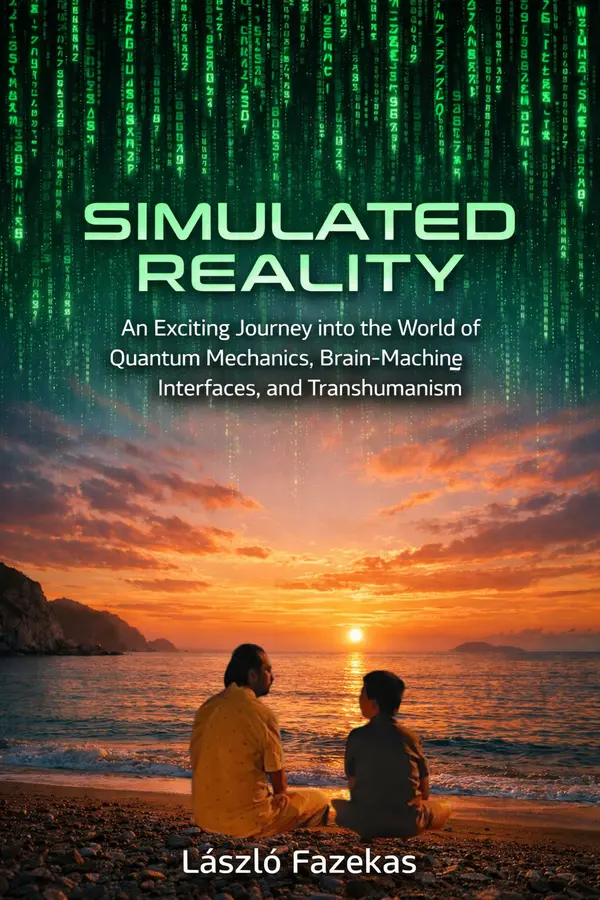
SIMULATED
REALITY
Are we living in a simulation?
An exciting journey into ideas that blur the boundaries between physics, mind, and technology, along with a clear and approachable exploration of the Simulation Hypothesis and its implications. But the deeper issue is not whether we live in a simulation. The book makes a clear case that we must build our own if we want to secure a truly sustainable future.
Watch the book trailer
A short introduction to Simulated Reality — a journey from quantum mechanics through brain-machine interfaces and transhumanism to the future of humanity.
What if reality is not fundamental?
Modern physics has already shaken our confidence in an objective world. Relativity reshaped space and time. Quantum mechanics questions whether reality even exists independently of observation.
But what if this is only the beginning? What if the universe behaves less like matter, and more like information? Simulated Reality follows the full arc: physics → technology → evolution, with clear explanations, grounded thought experiments, and a practical “so what?” lens.
Who is this book for?
- You take big questions seriously without needing mysticism.
- You want quantum mechanics explained clearly, not hand-waved.
- You follow AI and emerging tech and wonder what comes next.
- You care about consciousness, free will, and what “human” will mean.
What you’ll get
- A coherent map connecting physics, computation, and mind.
- A realistic view of brain–machine interfaces and immersive simulation.
- Thought experiments that sharpen intuition instead of muddying it.
- Implications first: a grounded “so what?” perspective on the future.
Introduction
We grow up assuming reality is the most solid thing there is. But the deeper we look, the less solid it becomes. Relativity teaches that space and time are not fixed. Quantum mechanics goes further. At the most fundamental level, nature refuses to behave like a single, objective story unfolding in the background.
Simulated Reality starts from a simple tension: our best physics strains the idea of a fully observer-independent world, while our technology is rapidly approaching the ability to generate worlds. Brain–machine interfaces already translate intention into action and can feed signals back into neural tissue. If the brain builds your experience from electrical impulses, then, at least in principle, those impulses could come from anywhere.
This book connects three arcs into one: what modern physics implies about the nature of reality, what computation and artificial intelligence imply about mind, and what transhumanism implies about the future of the self. It is written for curious readers who want clear explanations, grounded thought experiments, and a practical focus on implications, not just speculation.
The real question is not whether simulation is possible. It is what happens to meaning, identity, and humanity when it becomes normal.
About the author

I have been drawn to one question since childhood: what if what we call reality is not the deepest layer of existence? Over time, that curiosity evolved into a serious exploration of modern physics, computation, and emerging technologies.
Simulated Reality connects relativity and quantum mechanics with brain–machine interfaces, AI, and transhumanism. My aim is not mysticism, but clarity. Clear explanations, logical arguments, and a willingness to follow the implications wherever they lead.
View full profileContinue the conversation
The book is only the beginning. I regularly publish essays expanding on the themes explored here: quantum mechanics, simulation theory, decentralized systems, AI, and the long-term future of humanity.
If you enjoyed the ideas behind Simulated Reality, you will likely enjoy the ongoing discussion. New essays go deeper, challenge assumptions, and explore developments as they unfold.
Follow on SubstackThoughtful essays about reality, technology, and what may come next.
Get the book
Simulated Reality is available in multiple formats and languages. You can read it for free digitally or order a physical copy.
FAQ
Is the simulation hypothesis science or philosophy?
It sits at the boundary. The hypothesis touches physics and computation, but its conclusions depend on interpretation. Simulated Reality treats it as a serious idea, connects it to what modern physics actually says about observation and “objective reality,” and separates reasonable arguments from pure speculation.
Do I need a physics background?
No. The book is written for curious readers. Ideas are introduced step by step, with intuition-first examples and clear explanations. The goal is understanding, not gatekeeping.
Does the book claim we can prove we live in a simulation?
No. It explains why a definitive proof is unlikely, then focuses on the more useful questions: what would count as evidence, what kinds of observations would shift our confidence, and what the hypothesis would imply if it were true. It also explores the uncomfortable possibility that “objective reality” may be harder to define than we assume, even without invoking simulation.
Why do quantum mechanics and simulation belong in the same book?
Quantum mechanics forces us to confront interpretations where reality is not a single, classical story. Collapse, Many-Worlds, non-locality, retrocausality, and superdeterminism are all attempts to explain the same math. The book uses these interpretations to show why the simulation hypothesis is not the strangest option on the table, and why “reality isn’t fundamental” is a live question, not just sci-fi.
How do brain–machine interfaces fit into simulated reality?
Because experience is built from signals. The brain does not directly access the outside world. It receives electrical impulses and constructs the world you live in. If those impulses can be read and written, then a high-bandwidth interface could, in principle, feed a fully immersive world directly into the brain. The book surveys today’s paths, from electrode-based implants to biohybrid approaches and possible future nanotech routes.
Is this book optimistic or dystopian?
Neither by default. It treats simulated reality and transhumanism as powerful possibilities with real tradeoffs. Fully immersive virtual worlds could reduce physical consumption and reshape society, but they also raise hard questions about meaning, identity, and what we choose to value when “reality” becomes editable.
Is this book mainly about AI?
AI is a major thread, but not the whole story. The book connects physics, computation, and human enhancement. AI matters because it accelerates the path toward building convincing worlds, decoding brains, and eventually blurring the line between tool and self. But the core focus is the bigger picture: what those trends imply about reality and humanity.
Does the book argue for transhumanism and mind uploading?
It explores the argument seriously. It lays out the transhumanist vision: merging with technology, radical life extension, and the possibility of digital continuation. It also highlights the delicate point: what it would mean for a “you” to persist when the substrate changes, and why the question of identity becomes central.
What kind of book is it, practically speaking?
It is a guided journey. Each part opens with a short science-fiction story to prime the imagination, then shifts into clear, grounded non-fiction. You get explanations, thought experiments, and a coherent map of ideas that connect across physics, neuroscience, and the future of technology.
Where can I buy it?
Simulated Reality is available on Amazon in paperback and hardcover, and can be read for free as an eBook on Google Play Books (including the Hungarian translation).
Ready to explore Simulated Reality?
If reality is not fundamental, then understanding its rules may be one of the most important intellectual pursuits of our time. Not for escapism. Not for fantasy. But for clarity.
Simulated Reality connects quantum mechanics, computation, brain–machine interfaces, artificial intelligence, and transhumanism into one coherent framework. It does not promise certainty. It offers something more valuable: a structured way to think about what reality might be, and what humanity may become.
Want to go deeper first? Explore related essays:
The question is no longer whether technology can change our world. The question is whether it will eventually allow us to change reality itself.